Feuertisch-Brennstoffoptionen: Leitfaden für Landschaftsgestalter für Propan, Erdgas und Bioethanol
- Author:
- Ederson Morche
- Published:
Loading image...

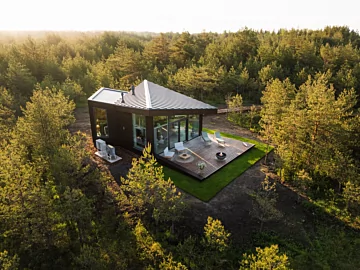 © dharmaresort.ee. Photo: Priidu Saart. saartvisuals.com
 Loading image...
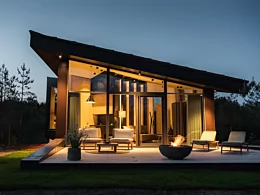 © dharmaresort.ee. Photo: Priidu Saart. saartvisuals.com
 Jedes Landschaftsprojekt hat einen Moment, in dem die Augen eines Kunden aufleuchten, wenn ein Feuerelement erwähnt wird. Es ist das Element, das einen Außenbereich von funktional zu unvergesslich verwandelt. Doch hinter dieser Vision steht eine entscheidende Entscheidung, die den Erfolg des Projekts prägen wird: Welcher Brennstofftyp wird die Flamme antreiben?
Für Landschaftsprofis geht es bei der Brennstoffauswahl nicht einfach nur um Wärmeleistung oder Ästhetik. Es geht darum, Infrastrukturbeschränkungen zu verstehen, Kundenerwartungen zu managen und Installationen zu liefern, die jahrelang einwandfrei funktionieren. Die falsche Wahl kann kostspielige Nachrüstungen, enttäuschte Kunden oder Sicherheitskomplikationen bedeuten, die Ihren Ruf schädigen.
Dieser Leitfaden beseitigt die Verwirrung um Propan, Erdgas und Bioethanol-Feuertische. Sie erfahren die technischen Spezifikationen, Installationsanforderungen und praktischen Überlegungen, die bei der Spezifikation von Feuerelementen für Wohn- und Gewerbeprojekte am wichtigsten sind. Ob Sie einen intimen Innenhof oder ein weitläufiges Hospitality-Gelände gestalten – das Verständnis dieser Brennstoffoptionen hilft Ihnen, Empfehlungen abzugeben, die Kunden begeistern und Ihr Fachwissen zeigen.
Understanding fire table fuel fundamentals
The fuel powering a fire table influences far more than flame height. It determines installation complexity, ongoing maintenance requirements, operating costs, and even where the feature can be positioned within a landscape design. Getting this decision right from the outset saves time, protects margins, and builds client trust.
How fuel choice shapes project outcomes
Every fuel type brings distinct characteristics that ripple through the entire project lifecycle. Propane offers portability but requires tank management. Natural gas delivers unlimited supply but demands infrastructure investment. Bioethanol provides unmatched placement flexibility but operates at different heat thresholds than gas alternatives.
These differences affect your scope of work, the trades you'll need to coordinate with, and the ongoing relationship you'll have with your client. A residential installation with existing gas infrastructure presents very different opportunities than a remote commercial venue without utility connections.
Key factors landscapers must evaluate
Before recommending any fuel type, assess the site's existing infrastructure, the client's usage patterns, and local regulatory requirements. Consider questions like: Does the property have natural gas service? Is the fire table position fixed or might the client want flexibility? Will the feature be used primarily for ambiance or as a heat source during cooler months?
According to industry guidance from the Landscape Industries Association, fire features rank among the top five most requested outdoor living elements, yet they also generate significant callback rates when fuel selection doesn't align with client expectations.
Client expectations vs practical realities
Clients often arrive with Pinterest-worthy visions but limited understanding of what different fuel types require. Your role is to translate their aesthetic goals into practical recommendations. Some clients imagine the romance of flickering flames but haven't considered where they'll store propane tanks. Others assume natural gas installation is straightforward, unaware of the trenching and permits involved.
Setting realistic expectations early prevents disappointment later. When you explain the trade-offs clearly, clients appreciate your expertise and trust your guidance on the details that matter.
Propane fire tables: Portable power for versatile projects
Loading image...

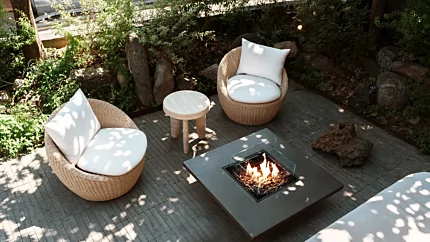
Propane remains the most popular fuel choice for fire tables, and for good reason. It combines meaningful heat output with installation flexibility that gas-line dependent options simply cannot match. For landscapers, propane fire tables often represent the path of least resistance, particularly for retrofit projects or properties without natural gas service.
How propane fire tables work
Propane fire tables connect to standard liquid propane cylinders, typically 9kg (20lb) tanks that fit discreetly within the table's base or in a nearby concealed location. A regulator controls gas flow to the burner, where electronic or manual ignition systems bring the flame to life.
Most quality propane fire tables produce between 40,000 and 65,000 BTU/h, generating substantial warmth that extends the usability of outdoor spaces well into cooler evenings. At maximum output, a standard tank provides approximately 8 to 20 hours of burn time, depending on flame height settings and ambient conditions.
Installation considerations for landscapers
The beauty of propane installations lies in their simplicity. There's no need to coordinate with gas fitters or obtain plumbing permits. You can position the fire table virtually anywhere within the landscape design, provided you maintain appropriate clearances from combustible materials and structures.
However, consider the practical aspects of tank access. Clients will need to exchange or refill tanks periodically, so ensure the storage location is accessible without disrupting the landscape aesthetic. Many premium fire tables feature integrated tank compartments that keep cylinders hidden while allowing easy access for replacement.
"When specifying propane fire features, always discuss tank logistics with your client upfront," advises the National Fire Protection Association's guidance on outdoor gas appliances. "Understanding refill frequency and storage preferences prevents frustration after installation."
Best applications for propane fire tables
Propane excels in scenarios where flexibility matters most. Rental properties benefit from the ability to reposition features as needs change. Properties without natural gas service gain access to high-output fire features that would otherwise require significant infrastructure investment. Clients who entertain in different areas of their garden appreciate the option to relocate their fire table seasonally.
Commercial installations in locations with limited infrastructure, such as wineries, rural event venues, or temporary hospitality setups, often rely on propane for its self-contained operation.
Propane advantages and limitations
Advantages:
Propane delivers immediate installation without infrastructure requirements. It produces substantial heat output suitable for cooler climates. The fuel is widely available at hardware stores, service stations, and dedicated suppliers. Equipment costs typically run lower than natural gas alternatives, and the ability to relocate installations adds long-term value.
Limitations:
Tank management requires ongoing attention. Clients must monitor fuel levels and arrange refills or exchanges. Operating costs exceed natural gas over time, particularly for frequent users. Some regions impose restrictions on propane storage or usage, especially in multi-dwelling developments or bushfire-prone areas.
Erdgas-Feuertische: Die Lösung für dauerhafte Installationen
Loading image...
 © @damarisurizardesign
 Für Kunden, die ein wartungsfreies Feuerelement mit unbegrenzter Brennstoffversorgung suchen, ist Erdgas die Premium-Wahl. Die höhere Anfangsinvestition zahlt sich durch niedrigere Betriebskosten und den Komfort aus, dass der Brennstoff während einer Zusammenkunft nie ausgeht.
Anschlussanforderungen für Erdgas
Erdgas-Feuertische werden über dedizierte Rohrleitungen direkt an die Gasversorgung des Grundstücks angeschlossen. Dies erfordert die Koordination mit einem zugelassenen Gasinstallateur, der die Versorgungskapazität bewertet, entsprechend dimensionierte Leitungen zum Standort des Feuertisches verlegt und sicherstellt, dass alle Anschlüsse den relevanten Normen entsprechen.
Die Dimensionierung der Gasleitung ist von erheblicher Bedeutung. Gemäß Branchenspezifikationen kann eine ¾-Zoll-Leitung bei 18 Metern (60 Fuß) bis zu etwa 138.000 BTU liefern, während eine 1-Zoll-Leitung bei 38 Metern (125 Fuß) etwa 175.000 BTU bereitstellt. Unterdimensionierte Leitungen führen zu enttäuschender Flammenhöhe und reduzierter Wärmeleistung, weshalb genaue Berechnungen in der Planungsphase unerlässlich sind.
Zusammenarbeit mit Gasfachleuten
Als Landschaftsgärtner liegt Ihre Rolle bei der Gasinfrastruktur eher in der Koordination als in der Ausführung. Bauen Sie Beziehungen zu zuverlässigen zugelassenen Gasinstallateuren in Ihrer Region auf, die die spezifischen Anforderungen von Außen-Feuerelementen verstehen. Stellen Sie ihnen Herstellerspezifikationen, einschließlich BTU-Anforderungen und empfohlenen Einlassdrücken, rechtzeitig vor dem Installationstag zur Verfügung.
Die Einplanung in Ihren Projektzeitplan verhindert Verzögerungen. Gasarbeiten erfordern in der Regel Genehmigungen und Inspektionen, die die Projektzeitpläne je nach Bearbeitungszeiten der örtlichen Behörden um Tage oder Wochen verlängern können.
Langfristige Kosten- und Leistungsvorteile
Während Erdgasinstallationen eine höhere Anfangsinvestition erfordern, verschiebt sich die Betriebswirtschaftlichkeit im Laufe der Zeit dramatisch. Erdgas kostet deutlich weniger pro BTU als Propan, und viele Hausbesitzer berichten, dass sie die Auswirkungen auf ihre Nebenkosten selbst bei häufiger Nutzung kaum bemerken.
"Für Kunden, die planen, ihr Feuerelement regelmäßig zu nutzen, wird Erdgas typischerweise innerhalb der ersten ein bis zwei Jahre des Besitzes wirtschaftlicher", stellen Leitlinien der Gas Appliance Manufacturers Association fest. "Der Wegfall der Tankwartung bietet zudem einen Lebensstilwert, der sich schwer quantifizieren lässt."
Erdgas-Feuertische liefern auch eine konstante Leistung. Es gibt keinen allmählichen Druckabfall wie bei einem sich leerenden Tank, was bedeutet, dass Flammenhöhe und Wärmeleistung bei jeder Nutzung stabil bleiben.
Vorteile und Einschränkungen von Erdgas
Vorteile:Unbegrenzte Brennstoffversorgung eliminiert die Tankverwaltung vollständig. Niedrigere laufende Betriebskosten kommen häufigen Nutzern zugute. Konstanter Druck liefert zuverlässige Flammenleistung. Die dauerhafte Installation steigert den Immobilienwert und signalisiert Qualität.
Einschränkungen:Professionelle Installationsanforderungen erhöhen die Vorlaufkosten erheblich. Die Position des Feuertisches wird nach der Installation der Gasleitungen fest. Grundstücke ohne bestehenden Gasanschluss stehen vor erheblichen Infrastrukturinvestitionen. Installationszeiträume verlängern sich aufgrund von Genehmigungs- und Inspektionsanforderungen.
Bioethanol-Feuertische: Saubere Verbrennung und Designfreiheit
Loading image...

 © Moran Gozali Interior Architecture / Photo: Ruslan & Gali Paul
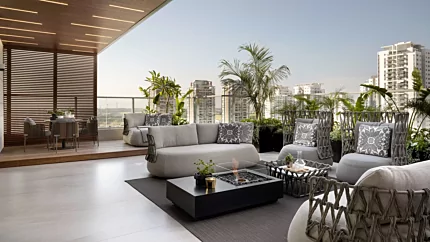
 Bioethanol stellt die vielseitigste verfügbare Brennstoffoption dar und bietet eine Installationsflexibilität, die weder Propan noch Erdgas erreichen können. Für designorientierte Projekte, bei denen Ästhetik und Platzierungsoptionen Priorität haben, eröffnen Bioethanol-Feuertische Möglichkeiten, die konventionelle Gasoptionen schlichtweg nicht bieten können.
Bioethanol als Brennstoffquelle verstehen
Bioethanol ist ein erneuerbarer Brennstoff, der aus fermentierten Pflanzenzuckern gewonnen wird, typischerweise aus Mais, Zuckerrohr oder Weizen. Bei der Verbrennung entstehen nur Waerme, Wasserdampf und minimales Kohlendioxid, etwa in der Menge, die von einigen Personen bei einem Gespraech ausgeatmet wird. Es gibt keinen Rauch, keinen Russ und keine schaedlichen Emissionen, die eine Belueftung erfordern wuerden.
Diese saubere Verbrennungseigenschaft unterscheidet Bioethanol von allen anderen Feuertisch-Brennstoffen. Es ist die einzige Option, die bei Verwendung mit entsprechender Ausruestung und in ausreichend beluefteten Raeumen sicher in Innenraeumen betrieben werden kann.
Installationsflexibilitaet und Platzierungsoptionen
Ohne Gasleitungen oder sperrige Tanks, die untergebracht werden muessen, koennen Bioethanol-Feuertische praktisch ueberall positioniert werden. Dachterrassen, Innenhhoefe, ueberdachte Veranden und sogar Innenraeume werden zu realisierbaren Standorten. Diese Flexibilitaet ermoeglicht es Landschaftsgaertnern und Designern, Feuerelemente in Raeume zu integrieren, in denen Infrastrukturbeschraenkungen sie sonst unmoeglich machen wuerden.
Der Installationsprozess selbst erfordert keine spezialisierten Gewerke. Bioethanol-Feuertische kommen betriebsbereit an, wobei der Brenner einfach mit dem mitgelieferten Zubehoer aus Brennstoffflaschen befuellt wird. Es gibt keine herzustellenden Anschluesse, keine einzuholenden Genehmigungen und keine laufenden Inspektionen.
Vielseitigkeit fuer Innen- und Aussenbereich
Die saubere Verbrennung von Bioethanol macht es zum einzigen Feuertisch-Brennstoff, der fuer Innenanwendungen geeignet ist. Hersteller, die nach Standards wie UL 1370 und EN 16647 produzieren, zertifizieren bestimmte Modelle fuer den Innengebrauch, typischerweise mit Anforderungen an Mindestaumvolumina und der Einbeziehung von Sicherheitswannen.
Diese Vielseitigkeit schafft ueberzeugende Moeglichkeiten fuer Projekte, die Innen- und Aussenzonen umspannen. Ein ueberdachter Alfresco-Bereich, der als Erweiterung des Innenraums fungiert, kann einen Bioethanol-Feuertisch aufweisen, der unabhaengig von den Wetterbedingungen funktioniert, ohne die Belueftungsbedenken, die Gasalternativen verbieten wuerden.
Premium-Bioethanol-Brenner, wie solche mit 8-Liter-Kapazitaet, liefern etwa 20.000 BTU/h und brennen 7 bis 9 Stunden pro Fuellung. Groessere Brenner bieten verlaengerte Brennzeiten von 8 bis 13 Stunden bei etwas geringerer Waermeleistung, optimiert fuer Ambiente statt Raumheizung.
Bioethanol advantages and limitations
Advantages:
Complete installation flexibility with no infrastructure requirements. Indoor and outdoor capability from a single fuel type. Clean burning produces no smoke, soot, or harmful emissions. Renewable fuel source appeals to environmentally conscious clients. Elegant, modern aesthetic suits contemporary design.
Limitations:
Lower heat output than gas alternatives makes bioethanol better suited for ambiance than primary heating. Fuel costs exceed natural gas, though they remain comparable to propane for moderate use. Manual refilling required between uses. Burn time limited by reservoir capacity.
Fuel comparison at a glance
Making confident recommendations requires clear understanding of how each fuel type performs across the factors that matter most to your clients and your projects. The following comparison synthesises the key specifications and practical considerations.
Heat output and performance comparison
Gas options deliver substantially higher heat output, making them preferable for clients prioritising warmth during cooler months. Bioethanol suits projects where ambiance, design flexibility, or indoor capability take precedence over raw heating power.
Installation and infrastructure requirements
Propane and bioethanol share the significant advantage of requiring no permanent infrastructure. A landscaper can install these fire tables as part of standard project delivery without coordinating additional trades or navigating permit processes.
Natural gas demands more complex project management. Budget for gas fitting costs, permit fees, and inspection time when quoting these installations. The infrastructure investment locks the fire table position, so thorough discussion with clients about optimal placement is essential before committing to gas line routes.
Ongoing costs and maintenance
Natural gas offers the lowest ongoing fuel costs for frequent users, often adding negligible amounts to existing utility bills. Propane costs more per hour of operation but avoids upfront infrastructure investment. Bioethanol fuel pricing sits between the two, with the convenience of simple bottle purchases offsetting higher per-hour costs.
Maintenance requirements remain minimal across all fuel types. Gas installations benefit from annual inspections by qualified technicians. Propane systems require periodic regulator and hose checks. Bioethanol burners need only occasional cleaning and use of quality fuel to maintain optimal performance.
Environmental and safety considerations
All three fuel types burn cleanly compared to wood, producing no particulate matter or visible smoke. Bioethanol offers the strongest environmental credentials as a renewable fuel source, with some studies indicating 59% to 86% lower greenhouse gas emissions compared to fossil fuel equivalents.
Safety certifications provide important assurance. Quality fire tables carry listings to standards such as UL 1370, ANSI Z21.97, and EN 16647, confirming they meet rigorous safety requirements for their intended applications.
Multi-fuel fire tables: Future-proofing your installations
One of the most valuable developments in fire table design is the emergence of products that accommodate multiple fuel types. These versatile units allow clients to change fuel sources without replacing the entire fire table, providing flexibility that conventional single-fuel options cannot match.
What are multi-fuel fire tables?
Multi-fuel fire tables are engineered to accept different burner configurations. A single fire table surround and frame can be ordered with bioethanol, propane, or natural gas burners, with conversion possible by swapping burner components rather than replacing the entire unit.
This design philosophy recognises that client circumstances change. A property might gain natural gas service years after initial installation, or a homeowner might relocate their fire table and lose access to gas infrastructure. Multi-fuel capability protects the investment against these eventualities.
When to recommend flexible fuel options
Consider multi-fuel fire tables for clients facing uncertain infrastructure situations. Properties in developing areas may gain utility services over time. Clients who relocate frequently benefit from equipment that adapts to different properties. Commercial operators appreciate the ability to optimise fuel choice based on operational requirements.
For premium residential projects, multi-fuel capability signals quality and forward thinking. It demonstrates that you've considered your client's long-term interests, not just immediate project requirements.
Specification and ordering considerations
When ordering multi-fuel fire tables, specify the initial fuel configuration while noting the product's conversion capability in your documentation. Ensure clients understand which components would need replacement for fuel conversion and retain manufacturer contact information for future reference.
Some manufacturers offer conversion kits that include all necessary components for switching between fuel types. Documenting this option at handover adds value to your service and positions you as a resource for future needs.
Matching fuel type to project requirements
With technical specifications understood, the practical question becomes: which fuel type suits which projects? Developing a systematic approach to this decision streamlines your specification process and ensures consistent outcomes.
Residential landscape considerations
Most residential projects present a choice between propane and natural gas, with bioethanol serving specific design opportunities. For properties with existing gas service and clients who value convenience, natural gas delivers the best long-term value. The infrastructure investment typically adds less than anticipated when incorporated into broader landscape construction budgets.
For properties without gas service, or for clients who prioritise flexibility, propane provides excellent performance without infrastructure commitment. Position tank storage thoughtfully, considering both aesthetics and practical access for refilling.
Bioethanol shines in residential projects where design constraints or indoor-outdoor integration create challenges for gas options. Covered entertaining areas, apartment balconies, and architectural features benefit from bioethanol's unique capabilities.
Commercial and hospitality applications
Commercial projects introduce additional considerations including usage intensity, operational efficiency, and regulatory compliance. High-volume hospitality venues typically favour natural gas for its unlimited supply and lower operating costs. A busy restaurant patio burning through multiple propane tanks weekly quickly justifies gas line investment.
However, venues in heritage locations, temporary installations, or properties with complex infrastructure limitations often find bioethanol or propane more practical. The installation flexibility allows fire features in spaces where running gas lines would be prohibitively expensive or physically impossible.
"Fire features in commercial settings need to balance aesthetic impact with operational practicality," notes guidance from the Australian Institute of Landscape Architects. "The best installations consider not just the immediate design vision but the long-term operational reality of the business."
Client consultation framework
Develop a consistent set of questions for client consultations:
- Does the property have natural gas service, and where is the nearest connection point?
- How frequently do you anticipate using the fire feature?
- Is the fire table position fixed, or might you want flexibility to relocate it?
- Will the fire feature be used primarily for ambiance or for meaningful heat?
- Do you have any interest in indoor fire feature capability, now or in future?
- What's your comfort level with ongoing fuel management versus set-and-forget operation?
These questions quickly reveal which fuel type aligns with client priorities, allowing you to make confident recommendations backed by professional reasoning.
Clearance and safety requirements
Fire feature installations carry significant safety responsibilities. Understanding clearance requirements protects your clients, your business, and your professional reputation. While specific requirements vary by jurisdiction and manufacturer, consistent principles apply across all fuel types.
General clearance guidelines
Most fire table manufacturers specify minimum clearances from combustible materials:
| Location | Minimum Clearance |
|---|---|
| Overhead (combustible ceilings, pergolas) | 1.8m (6 ft) minimum |
| Sides (combustible structures) | 610mm (24 in) from sides |
| Adjacent combustibles below tabletop | 203mm (8 in) from sides and back |
| General structure clearance | 3 to 4.5m (10–15 ft) recommended |
| Seating distance | 900mm (3 ft) wood / 380mm (15 in) gas |
These figures represent general guidance. Always verify requirements against specific manufacturer documentation and local building codes, as requirements vary by jurisdiction and product certification.
Fuel-specific safety considerations
Propane's heavier-than-air characteristic requires attention to ventilation in enclosed or semi-enclosed spaces. Ensure adequate airflow around tank storage locations and avoid positioning tanks in pits or depressions where leaking gas could accumulate.
Natural gas installations must comply with relevant standards including NFPA 58 for storage and handling, and ANSI Z21.97 for outdoor gas appliances. Licensed gas fitters bear responsibility for code compliance, but as the coordinating professional, understanding these requirements helps you identify potential issues early.
Bioethanol installations require attention to fuel handling procedures. Ensure clients understand never to refill burners while hot, and store fuel in cool, ventilated locations away from ignition sources.
Working with local regulations
Building codes, fire regulations, and planning requirements vary significantly between jurisdictions. Some local authorities require permits for any permanent fire feature installation. Others impose seasonal restrictions during high fire danger periods. Multi-dwelling developments often have specific rules about outdoor fire features.
Make checking local requirements a standard part of your project planning process. Contact your local council or building authority early in the design phase to identify any restrictions or permit requirements that might affect fuel type selection or fire table positioning.
Selecting the right fuel for lasting client satisfaction
The fire table at the heart of your landscape design will become a gathering point for years of memories. Your fuel recommendation shapes not just the installation process, but the ongoing experience your client enjoys every time they gather around the flame.
Propane delivers accessible warmth with minimal infrastructure commitment, perfect for clients who value flexibility or properties without gas service. Natural gas rewards the upfront investment with unlimited convenience and the lowest long-term operating costs. Bioethanol unlocks design possibilities that gas options cannot achieve, bringing fire features indoors and into spaces where infrastructure constraints would otherwise prevent them.
For landscaping professionals, the ability to confidently recommend the right fuel type for each unique project distinguishes expert practitioners from those who simply install what clients request. Your understanding of installation requirements, operating characteristics, and long-term implications adds genuine value to every fire feature specification.
Consider multi-fuel fire tables for projects where circumstances might change, protecting your client's investment against evolving needs. And always verify local regulations and manufacturer specifications before finalising your recommendations.
The next time a client's eyes light up at the prospect of a fire feature, you'll have the knowledge to translate that vision into a recommendation that performs beautifully for years to come. That's the kind of expertise that builds reputations and generates referrals in our industry.